You don’t get to die before me! No one else is dying before me… Not again! Not ever again!
Tpr. Bailey Pittman
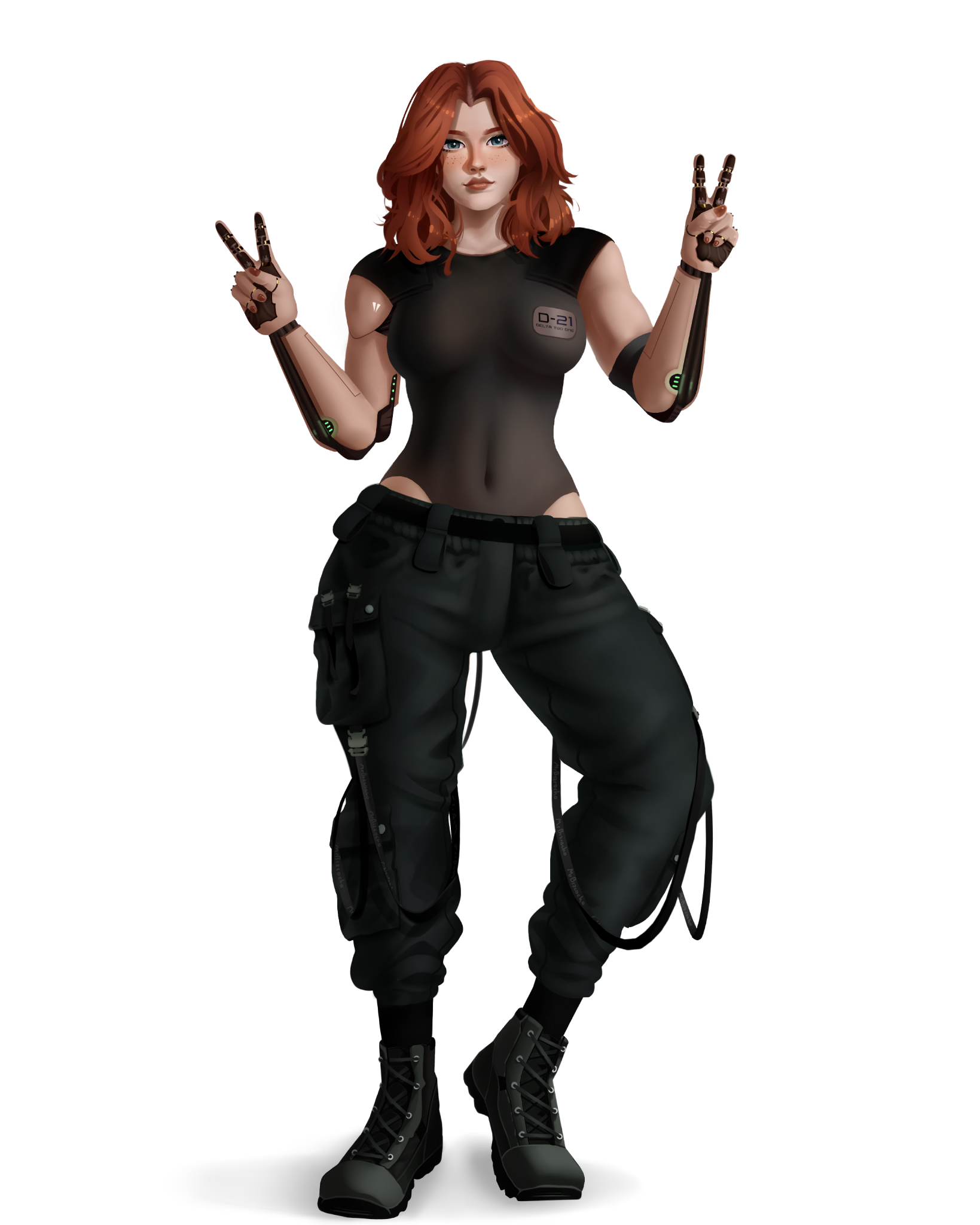
Bailey Pittman is the demolitions specialist of Delta Two One, serving under Cpl. May Zhang within the Imperium Coalition Special Shock Assault Service. Before joining Delta, she served as an ICDF rifleman with the 101st Battalion and later specialised in reconnaissance. She is the first member of her family to be accepted into the ICSSAS.
Loud, restless and regularly accused of being a bad influence, Bailey is usually easiest to know while nothing serious is being discussed. She jokes, needles her peers and reaches readily for sarcasm, particularly when a conversation drifts somewhere uncomfortable. None of that makes her unserious when it matters.
Bailey is intensely protective of the people around her. She is quick to put herself between somebody else and danger, quick to decide who is responsible when somebody gets hurt, and not always patient enough to reconsider that judgement afterwards. These traits make her a dependable soldier and, at times, a difficult person.
Her path into Delta Two was not straightforward. Bailey’s first military career ended during an ICDF deployment when her platoon’s insertion craft were sabotaged. Five soldiers were killed or dismembered, two were left permanently paralysed, and Bailey survived with injuries that resulted in the loss of all four limbs.
Four years of rehabilitation, training and repeated entrance examinations eventually returned her to military service. The soldier who returned was still Bailey Pittman. She simply had considerably more to carry with her.
Bailey is easiest to know while nothing serious is being discussed. Around Delta Two she is energetic, generous and regularly accused of being a bad influence. She likes noise, momentum and other people; sarcasm comes easily, particularly when a conversation drifts too close to something she would rather leave buried.
It is not quite an act. Bailey genuinely enjoys being loud, reckless and difficult to bore. It is also useful camouflage. Alone, the momentum tends to stop.
Much of Bailey’s life is spent around the same people she deploys beside. Delta Two bickers, trains and parties between assignments, and Bailey fits naturally into that rhythm. Mía Alvarado is her closest friend; their bond is closer to that of sisters than ordinary squadmates, and Bailey regards the wider patrol as an extension of the same small circle.
That familiarity gives Bailey room to be ordinary in ways the battlefield does not. She can needle Tobi, trade remarks across a room, irritate May, or simply be the person most likely to push a quiet evening into something louder. The people around her know the difference between Bailey making noise because she is enjoying herself and Bailey making noise because silence has become uncomfortable.
Bailey’s earlier reconnaissance career still matters to the soldier she became. She is practical, impatient with abstractions and interested in information she can act upon: where somebody is, what stands between them and safety, what needs opening, and what needs stopping. Demolitions gives that directness a useful shape.
Her value to Delta Two is not novelty. She was an athlete and a capable shot before her injury, became a reconnaissance specialist before joining the ICSSAS, and then retrained into a role that rewards judgement under pressure. The prosthetics change what her body can do and how she must do some things; they are not the source of her discipline, aggression or competence.
Bailey lives with post-traumatic stress and obsessive fears centred on hurting the people closest to her. The sabotage is part of that. So are the prosthetics that put her back in uniform. Their strength is easy to trust; their touch is not.
Medication helps. So does work. Bailey obtains her medication outside the subscription route used by the service, which meant it did not prevent her from technically passing the assessments required to return. Whether that counts as recovery is another matter. Bailey mostly treats the question as irrelevant.
When training teaches you to get on with it or die, getting on with it can look remarkably similar to healing from a distance.
Bailey’s morality is immediate. She has little interest in why the Myrkild and their Nadirs are on Errack, or why there are only eight stars in the sky. Those questions can belong to somebody with the time and patience for them. Bailey cares about the person standing beside her, the person unable to defend themselves, and the person responsible when either is hurt.
She is intensely loyal to her peers and quick to divide a crisis into ours and theirs. Once Bailey decides somebody knowingly harmed another person, sympathy for their reasoning tends to disappear. That makes her dependable when seconds matter and dangerously heavy-handed when her first judgement is wrong.
I don’t care if you’re stealing to feed your children, or whatever, I care if you hurt someone whilst doing it. You don’t have the right to destroy some innocent person’s life for your own gains.
Tpr. Bailey Pittman
There is an uncomfortable contradiction in this. Bailey is terrified that the power in her artificial limbs might hurt somebody she cares about, yet she fought for years to return to a profession built around violence. To her, these are not opposing impulses. They are the same promise taken too far: if somebody is going to stand between danger and the people around her, Bailey wants it to be her.
Bailey has served with Delta Two One for over two years. She has an incredibly close bond with all operators of Delta Two One and regards Delta Two Two as some of her closest friends. Mía and Bailey, in particular, are best friends.
First in command of Delta Two One, the motherly May Zhang is the ‘firm but fair’ leader. Tactically and strategically minded, May has a quiet persona and is all too happy to sit and watch the antics of her squadron as they bicker or party between assignments.
Designated machine gunner of Delta Two One, Tobi is a gentle giant — with muscles to show for it. Armed with a lightweight, gimballed exo-frame mount for his weapon and a back case of ammunition, most things tend to run or hide once rounds start flying.
Louis is the designated marksman for Delta Two One, with wicked reflexes and a history in reconnaissance. Louis is a lethal hunter and, surprisingly, an amazing chef — all those emergency rations gave him a strong love for good food.
Second in command of Delta Two One. As a CQB and hand-to-hand specialist, Akanni earned his surname upon joining the ICSSAS and has since only become more effective in his role as a team leader.
The designated marksman for Delta Two Two, Hannah has proven to be a truly lethal operator. Though Hannah is quieter and more introverted than many of her comrades, when in uniform or on mission she is focused and determined to be useful.
Mía and Bailey have a sister-like bond. As best friends they spend much of their free time together. As the designated machine gunner for Delta Two Two, Mía is short-tempered and all too happy to saturate an area with high-calibre rounds.
Designated demolitions specialist, Ilya has an innate ability to make things catch fire or go ‘boom’ with minimal resources, often using little more than scraps left lying about. Chemistry has always been a passion of Ilya’s; now he gets to fight for and defend his team with that same passion.
From adolescence, Bailey showed great skill in athletics and shooting. She participated in three teen CrossFit championships and won a ’Run ‘n’ Gun’ competition by the age of fifteen. These two factors no doubt played a role in the local ICDF branch head-hunting her for enlistment at sixteen.
Bailey began her career with the Imperium Coalition Defence Force as a rifleman in the 101st Battalion, eventually specialising in reconnaissance. She served for almost three years in this role before everything went wrong.
During deployment on an ICDF mission, Bailey’s insertion vehicle was sabotaged along with the rest of her platoon’s. The destruction caused the death and dismemberment of five soldiers, the permanent paralysis of two more, and irreversible damage to Bailey’s limbs.
Following the devastation inflicted upon Bailey’s platoon, she was benched from service until she could again pass mental and physical health assessments as well as the basic entrance exams.
After roughly four years of persistent training, exercising and tuning her prosthetics, Bailey retook her entrance exams for the third year in a row and passed near the top of the class, allowing her to re-enter the ICDF.
Following her re-enlistment to the ICDF, Bailey applied for a role within the ICSSAS straight away.
Joining Delta Squadron, Bailey specialised as a demolitions expert and has held this position for over two years — making her the youngest operator of Delta Two One.
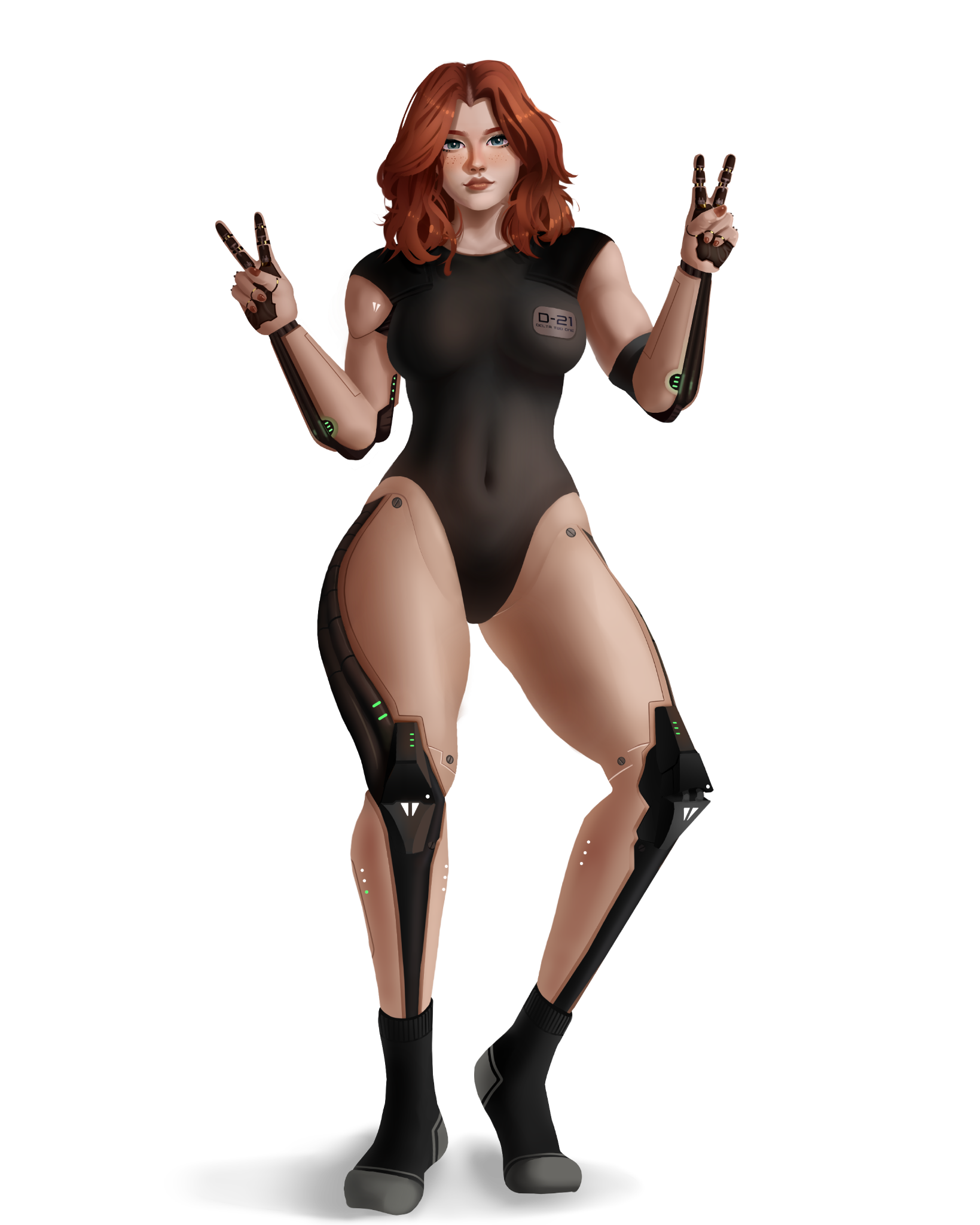
Bailey is fitted with synthetic biomechanical prosthetics built to reproduce human proportions and movement closely enough that, beneath clothing, much of their extent can be easy to miss. Her right arm begins at a shoulder-disarticulation interface, her left at a transhumeral interface, while both legs are transfemoral amputations. Her natural hips remain intact; the leg assemblies continue from the shortened femurs to replace both knees, lower legs and feet.
Her current prosthetics retain a recognisably human silhouette, with flesh-toned protective housings covering much of the upper limbs and thighs. The illusion deliberately breaks around several joints, couplings and lower-leg assemblies where harder mechanical components remain exposed. These areas are easier to inspect, service and replace after damage than a fully cosmetic covering would be.
As Bailey’s prosthetics are military-grade, they are built around priorities different from civilian replacements. Their actuators favour speed, torque, impact tolerance and sustained load over delicate manipulation. She can sprint, climb, absorb hard landings and apply considerably more force than her natural limbs once could, but tasks that depend on fractions of pressure demand more conscious control.
The same compromise exists in sensation. Bailey’s specification uses a lower density of artificial sensory nerves, with pain signals deliberately reduced so that damage to a prosthetic does not incapacitate its operator as readily in combat. Position, resistance and contact can still be felt, but the information reaching her brain is weaker and less detailed than natural touch. Years of training mean she does not need to think through every step or every movement of a finger, but fine control can still require sight, repetition and learned restraint.
That uncertainty has become one of the central focuses of Bailey’s obsessive-compulsive symptoms. Her fear is not usually that the prosthetics will fail catastrophically. It is that they will work exactly as designed while she misjudges the force she is applying. She trusts them to break through a door, carry a wounded trooper or keep fighting after an injury that would put somebody else on the ground. Trusting them with somebody she cares about is harder.
I miss holding you, feeling your skin, but these damn prosthetics are only good for killing. I hate them, I hate the people who took my hands, who left me alive in this broken body. Why didn’t I die like the others? Still… I won’t let them win. I’ll use these limbs to protect others, to make a difference. That’s what keeps me going, knowing I can make a change despite everything they took.
ICSSAS operators wear a waterproof, skin-tight, anti-microbial bodysuit beneath their fatigues to prevent smell, promote healthy conditions and keep the user warm. Key areas are lined with an ultra-durable fibre intended to resist ordinary piercing and cuts.
Combat fatigues are dark grey with subtle camouflage patterning and a plain dark-grey interior, tailored to fit each ICSSAS operator.
Armour is matte dark grey, matching the slightly lighter inner material of the fatigues. Solid plates are backed by a layer of pressure-responsive gel to reduce harsh impacts and physical shock.
In addition to their dark-grey armour-tailored fatigues and bodysuits, each ICSSAS operator is supplied with a choice of helmet and helmet modifications. Standard features include an electrochromic transparent-metal lens; an AR HUD capable of switching between multiple light-spectrum filters and displaying sensor information; built-in microphone and speaker arrays for communication and improved situational awareness; and a filtered rebreather for temporary oxygen supply in hostile environments.