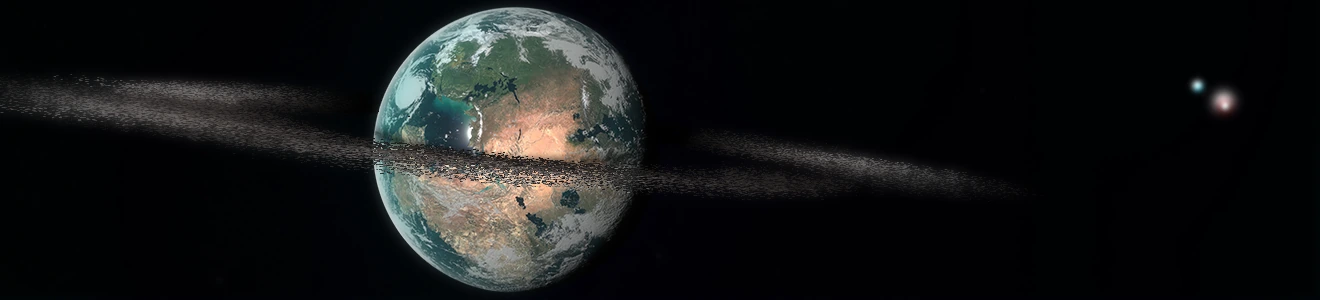
Errack/ˈɛræk/
10 min read
Content notes
Nestled in the Degel system, Errack presents a paradox: a life-sustaining planet teeming with rich plant life and biodiversity, yet a world of savage beauty and unforgiving extremes. Towering mountains pierce skies above expansive jungles teeming with both vibrant life and lurking horrors, while arid deserts push the limits of ecological adaptation. Every corner of Errack showcases nature’s ingenuity and ferocity, demanding respect and resilience from all who dare to inhabit it.
Orbital period
Section titled “ Orbital period”Most societies on Errack subscribe to a common calendar built around the planet’s orbital period:
- Year: 364 standard days.
- Months: 13 months of 28 days.
- Weeks: four 7-day weeks per month.
- Intercalary day: one Zero-day outside the normal month cycle.
- Leap correction: one additional leap day every four years.
[!vc-indent]
Seasons
Section titled “Seasons”Each of Errack’s four seasons lasts approximately 3.25 months. In the old tongue they are known as:
- Vetrnaetr — “Winter nights”; winter.
- Blómvakning — “Bloom Awakening”; spring.
- Sumar — summer.
- Haust — “Harvest”; autumn.
[!vc-indent]
Vetrnaetr
Section titled “Vetrnaetr”The season of withering. When the twin moons hang low and pale in the sky, the world succumbs to Vetrnaetr. Frost creeps from the shadowed hollows, gnawing at the edges of forest and fen. Rivers slow beneath glassy sheaths of ice, and the wind carries the howls of beasts and the groan of ancient trees. Fires burn low, and the living huddle close, telling tales of the old gods and the long night. It is a season of endurance, when the weak are culled and only the cunning or the strong persist. Yet in the silence, seeds of hope sleep beneath the snow, awaiting the touch of returning light.
Blómvakning
Section titled “Blómvakning”The season of fertility. As the grip of winter loosens, Blómvakning unfurls across Errack like a great, verdant tide. The land stirs—roots crack the thawing earth, and pale shoots reach hungrily for the sun. Jungles riot with colour, rivers swell with meltwater, and the air is thick with the scent of new growth and the calls of returning beasts. This is a season of courtship and birth, of ancient rites and wild revels beneath blossoming boughs. Life surges in reckless abundance, and every creature, from the smallest beetle to the mightiest titan, seems driven by the fever of renewal.
The season of fire. Under the unblinking gaze of Errack’s sun—Degel—Sumar ignites the world. Days stretch long and searing; the jungles steam, the highlands shimmer, and even the rivers run low and sluggish. Lightning storms prowl the horizon, setting the dry grasslands ablaze, while predators grow bold and hungry in the heat. Tribes and clans gather for contests of strength and daring, forging alliances and settling old scores. Sumar is the season of passion, conflict and creation, when the world is at its most alive and its most dangerous.
The season of reaping. As the sun dips and shadows lengthen, Errack enters Haust. Leaves bleed gold and crimson, and the air grows sharp with the promise of frost. It is a time of harvest and reckoning, when the bounty of the land is gathered and the debts of the year are paid. Hunters and gatherers roam far, and the people give thanks—and offerings—to the old spirits for another year survived. Yet beneath the celebration lies a note of dread, for all know the long night is coming and the world must be readied for its return.
Planetary composition
Section titled “ Planetary composition”Errack’s geological makeup presents a fascinating anomaly among terrestrial planets, its resource-rich environment offering both opportunities and challenges for its inhabitants and potential colonisers.
[!vc-indent]
Geography
Section titled “Geography”Across vast swathes of Errack’s surface, Tideglass scars the landscape. These formations follow the Wyrdweave’s webs and are often hotspots for Resonants due to the Wyrdweave’s Resonance-amplifying powers.
[!vc-indent]
Nareth
Section titled “Nareth”The bones of Nareth rise in jagged ridges and endless forests, a land where stone and root entwine in an ancient pact. Here, the wind howls across glacier-fed rivers and through canyons carved by forgotten ice. Tideglass scars split the earth like veins of frozen lightning, humming with the restless power of the Wyrdweave. In the shadow of towering pines, life endures: vast herds roam the tundra, and the deep woods shelter both predator and prey. To walk Nareth is to feel the pulse of the world’s endurance, to breathe the cold breath of its primal heart.
Voldrith
Section titled “Voldrith”Voldrith sprawls from the frostbitten north to the sun-baked steppes, a continent of contrasts and convergences. Empires have risen and fallen upon its plains, their ruins now claimed by wild grass and the slow encroachment of forest. Here, the Wyrdweave’s webs knot and tangle, creating places of uncanny resonance—cities built atop these nexuses thrum with strange energies, and old wounds in the land still bleed Tideglass. Mountains split the horizon, ancient rifts marking the scars of cataclysm and the boundaries of forgotten realms. Voldrith is the world’s memory, a place where unity and division are written in stone and story alike.
Zanbara
Section titled “Zanbara”Under a relentless sun, Zanbara stretches from golden savannah to brooding jungle, from salt-choked desert to the green embrace of ancient river valleys. Life here is a contest of endurance and adaptation, every root, and claw honed by the struggle for survival. Tideglass monoliths rise from the plains, casting long shadows that mark the passage of seasons and the migrations of beasts. The Wyrdweave’s resonance is fierce, often manifesting in sudden storms or uncanny blooms after the rains. Zanbara is the world’s crucible, a place of beginnings and endings, where every day is a test and every night a triumph.
Ossara
Section titled “Ossara”Ossara is a continent of water and wind, its islands scattered like jewels across the endless sea. Volcanic peaks rise from turquoise lagoons, their flanks cloaked in mist and ancient forest. The ocean is both highway and barrier, shaping the lives of those who dwell here into rhythms as fluid as the tides. Tideglass reefs shimmer beneath the waves, and storms born in the open sea sweep across archipelago and atoll, leaving behind new land and legend. The Wyrdweave’s influence is subtle but ever-present, guiding navigators and dreamers alike. Ossara is a realm of horizons, where every journey is a leap into the unknown.
Seravax
Section titled “Seravax”Seravax coils in lush, fevered abundance: jungles steaming under a heavy sky, rivers twisting like serpents through tangled green. The land is alive with secrets—ruined temples swallowed by vines, creatures both wondrous and lethal lurking in the undergrowth. Volcanic highlands brood over the lowlands, their slopes veined with Tideglass that glows at dusk. Here, the Wyrdweave’s resonance is wild and unpredictable, shaping both beast and blossom into forms found nowhere else. To journey through Seravax is to brave beauty sharpened by danger, to follow the river’s song into the heart of the unknown.
Radioactive elements
Section titled “Radioactive elements”Beneath Errack’s savage beauty thrums a thorium-powered pulse. Vast “energy reefs” of radioactive thorium lace continental shelves like subterranean lightning, their faint blue glow visible in deep crevasses. The planet’s crust and mantle harbour an unusually abundant supply of thorium, a radioactive element crucial for advanced energy production. This abundance stands in stark contrast to the scarcity of uranium and plutonium, typically more common in planetary bodies. This unique distribution of radioactive materials has profound implications for Errack’s energy landscape and technological development.
- Thorium: abundant throughout the planet’s crust, often found in concentrated deposits within igneous and metamorphic rocks. Its presence has shaped Errack’s geothermal activity and offers vast potential for nuclear energy production.
- Uranium and plutonium: remarkably scarce, existing only in trace amounts. Their rarity has steered Errack’s civilisations away from traditional nuclear-fission technologies.
Rare earth elements
Section titled “Rare earth elements”Errack boasts a rich composition of rare earth elements, with concentrations surpassing those typically found on Earth-like planets. These elements play crucial roles in advanced technologies and have become cornerstones of Errack’s industrial and technological sectors.
[!vc-indent]
Notable scarcities and alternatives
Section titled “Notable scarcities and alternatives”
- Lead: exceptionally rare on Errack, comprising only about a millionth of one percent of the planet’s crust (0.005 ppm). Its scarcity makes it a highly prized resource and has necessitated alternative approaches to radiation shielding and other applications where lead would otherwise be common.
- Bismuth: a widely adopted alternative whose lead-like properties make it valuable across several applications:
- Ammunition: bismuth is commonly used in projectiles, often cased in copper, iron, or steel to maintain material stability for penetration.
- Radiation shielding: its high density makes it an effective substitute for lead in radiation-protection equipment.
- Industrial uses: bismuth alloys appear in low-melting-point applications, soldering, plumbing, and electronics, though alloying is often necessary to compensate for its brittleness.
- Sunset bronze: bismuth-bronze alloys have historically been used to create shimmering statues of notable figures and events.
Flora and fauna
Section titled “ Flora and fauna”The species across Errack are vast and varied, for Errack’s living world is as savage as it is spectacular. Below is a selection of plants and creatures that are well known world-over and have persisted throughout the ages. More localised flora and fauna belong to their relevant era and region.
[!vc-indent]
- Emberbloom: a fire-adapted flower with petals that range from deep orange to iridescent gold. Its seeds require intense heat to crack open, and the plant often blooms en masse after wildfires, painting the landscape in fiery hues. The blooms are prized for their resilience and are woven into victory garlands.
- Ironspine thistle: a squat, sprawling bush with metallic, razor-edged leaves and deep purple flowers. Its roots break up hard, mineral-rich soils, making it a pioneer species after landslides or eruptions. The thistle’s barbs are used as natural needles.
- Veilwort: a delicate, silver-leaved creeper found in the misty undercanopies of Errack’s jungles. It produces small, bell-shaped flowers that drip with a sweet, narcotic nectar, attracting both pollinators and foragers. Veilwort is often used in ceremonial teas and as a peace offering between rival clans.
- Sable heather: a low, dense shrub with blackish-purple blooms and silvery stems, thriving in rocky, windswept highlands. Sable heather is a symbol of endurance and is used to flavour spirits and teas. Its roots stabilise cliffs and prevent landslides.
- Bismuth beetles: iridescent, armoured insects that feed on mineral deposits. Their shells are collected for jewellery and ceremonial armour.
- Ash serpents: venomous snakes that thrive in volcanic regions, their scales patterned like molten rock.
Ecological note
Section titled “Ecological note”
- Octannual tsunami season: every eight years, due to Errack’s twin moons, the great tides reshape coastlines, trigger mass spawnings and bring rare deep-sea flora to the surface.
Twin moons
Section titled “ Twin moons”Errack is orbited by two moons, the Eye of Vordr and the Eye of Visi. One of these sibling moons is typically around 50 km closer to Errack and therefore orbits slightly faster than the other. Every four years, the moons orbit close enough to each other that they switch places: the more distant moon becomes the closer moon, and vice versa.
[!vc-indent]
Every eight years, the slightly larger of the twin moons causes an increase in tidal waves, producing an octannual tsunami season. Some cultures celebrate this by hosting surfing competitions. The increased water level also enables easier fishing of Titans, as they can come closer to the coastline and surface. Titans have also been observed following the Eye of Vordr around Errack, apparently exploiting the greater vertical hunting space created by the higher waters.
Planetary rings
Section titled “ Planetary rings”In addition to its twin moons, Errack boasts a wide but faint ring system around its equator. These planetary rings are unfortunately the cause of many asteroids and comets becoming meteors. Whilst the resulting meteor showers are usually enjoyed for their stunning displays, some have also caused substantial destruction on rare occasions.
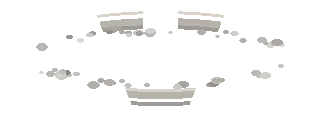 Rings of Errack — artwork by Elias Vail.
[!vc-indent]
Creation myth
Section titled “Creation myth”It is said that there was once a being on Errack so strong that they were able to pierce the clouds with their javelin. One day they threw the spear so violently and swiftly that it flew amongst the stars and split the skull of a god in two. Now all that remains of the old god are fragments of their skull and teeth orbiting Errack’s waist, and the god’s two eyes: Vordr and Visi.
The Shards
Section titled “ The Shards”Overhead, a ghostly asteroid belt shimmers faintly, while two ominous moons cast an eerie glow upon the landscape, their celestial dance influencing the planet’s volatile tides and magnetic fields. This asteroid belt is accentuated by large, sharp, crystalline rocks that make up the visage of a thorned crown around Errack’s waist. The Shards are orbital fortresses tethered to Errack: stations carved into, and reaching outwards along, one side of large asteroids fetched from the far reaches of the Degel system and now bound to Errack by space elevator.
The use of such large, dense asteroids serves a dual purpose:
- Protection: the asteroid acts as a shield for the station-fortress and its tether, protecting both from debris moving through Errack’s ring system.
- Development: the captured body provides a vast foundation upon which habitation, industry, defence, and other infrastructure can be built.
Referenced by
1 recordSpecies
- MyrkildUniversal